



For many players, multiplayer games used to be the place you went to relax. You logged in, played a few matches, maybe lost a few, maybe won a few, and logged off feeling entertained.
Today, that same login often feels different.
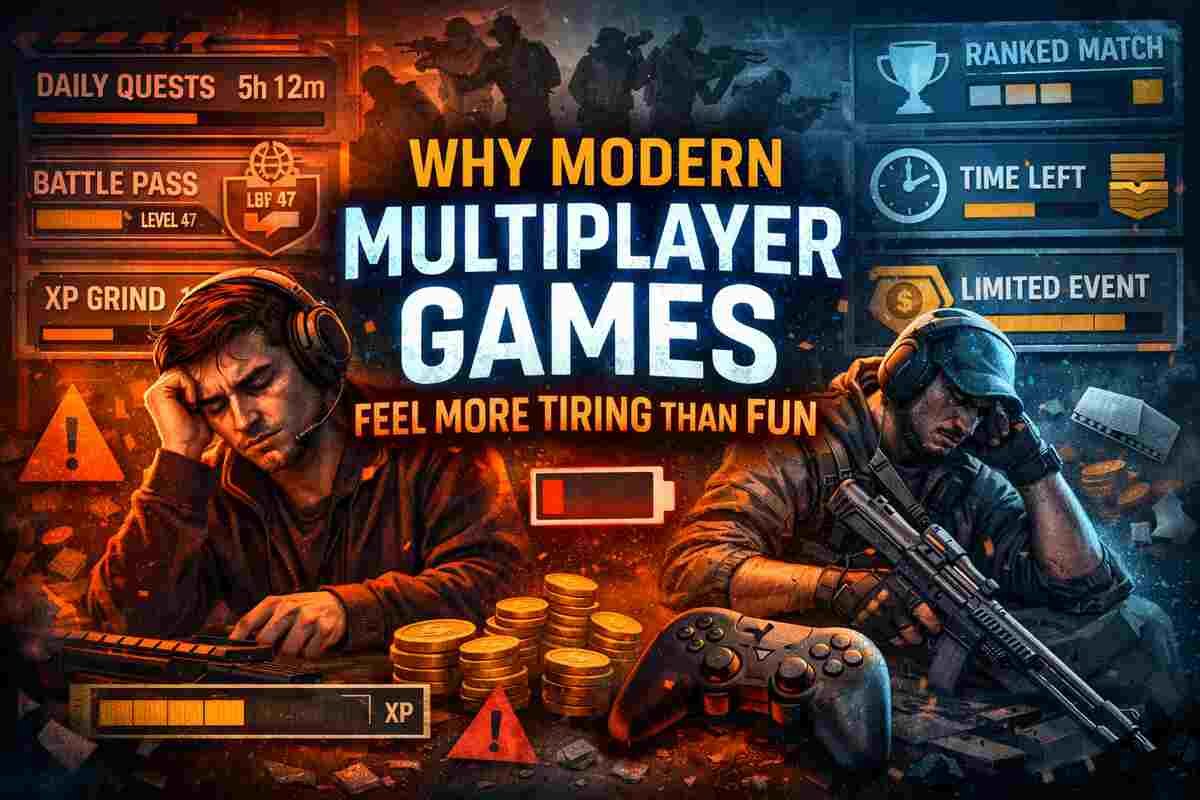
You open the game, and before you even play, you’re greeted by daily challenges, limited-time events, battle pass reminders, seasonal objectives, ranked decay warnings, and multiple currencies asking for your attention. Instead of excitement, there’s a subtle sense of pressure.
You’re not imagining it.
Modern multiplayer games genuinely feel more tiring than fun, and it’s not because players have changed — it’s because game design has.
Fun Slowly Turned Into Obligation
Older multiplayer games were built around a simple loop:
play → enjoy → repeat.
Progress existed, but it wasn’t constantly demanding your attention. You played because you wanted to, not because something would expire if you didn’t.
Modern multiplayer games flipped this dynamic.
Daily and weekly challenges now dictate how you should play. Seasonal events punish absence. Battle passes create invisible deadlines. Even casual playlists often tie rewards to time-limited objectives.
The result is subtle but powerful:
playing becomes an obligation, not a choice.
When fun is tied to schedules, players stop asking “Do I feel like playing?” and start asking “What will I miss if I don’t?”
That question alone changes how a game feels.
Endless Progress Killed Satisfaction
On paper, infinite progression sounds great. There’s always something to unlock, always a bar to fill, always a reason to keep going.
In practice, it removes one of the most important parts of enjoyment: completion.
Older games let you finish things. You unlocked a weapon, mastered a map, or reached a rank — and that achievement stayed meaningful.
Modern multiplayer games rarely allow that sense of closure.
Season resets wipe progress. New passes replace old ones. Power creep makes yesterday’s unlocks feel irrelevant. Instead of satisfaction, players experience a constant low-level anxiety that they’re falling behind.
When nothing ever ends, nothing ever feels complete.
Skill-Based Matchmaking Changed the Emotional Tone
Skill-based matchmaking was introduced to create fairer games. And technically, it often succeeds.
Emotionally, it creates a very different experience.
In tightly balanced lobbies, every match demands focus. Every mistake feels costly. Casual experimentation is punished quickly. There’s rarely a “relax and coast” match anymore.
Older multiplayer games had natural skill variance. Some matches were intense. Others were lighter. That fluctuation gave players room to breathe.
Today, the system tries to keep every match competitive — and constant competition is exhausting, especially when you’re just trying to unwind after a long day.
Social Pressure Is Higher Than Ever
Multiplayer games are no longer just games. They’re social environments with expectations.
You’re expected to:
- keep up with friends’ ranks
- understand evolving metas
- perform consistently
- not “throw” matches
Even unranked modes often carry unspoken performance pressure, amplified by voice chat, visible stats, and post-game breakdowns.
What used to be play has slowly turned into performance.
And performance, by nature, is draining.
Cognitive Overload Is the Silent Killer
One of the least discussed reasons modern multiplayer games feel tiring is mental clutter.
Menus are denser. Systems overlap. Currencies stack. Loadouts, perks, mods, boosts, events, challenges, shops, and notifications all compete for attention.
None of these systems are individually terrible.
Together, they create constant cognitive load — even before a match begins.
Your brain is already making decisions, tracking progress, and managing priorities before you actually start playing. By the time the match ends, you’re tired not just from gameplay, but from processing the ecosystem around it.
This Isn’t Player Burnout — It’s Design Fatigue
It’s easy to label this feeling as “burnout,” but that places the blame on players.
What’s really happening is design fatigue.
Games are optimized for:
- retention metrics
- engagement curves
- monetization windows
Fun still exists, but it’s often secondary to systems designed to keep you logged in longer and returning more frequently.
Players aren’t tired of games.
They’re tired of being managed by them.
Why Quitting Doesn’t Always Fix the Feeling
Many players take breaks hoping the joy will return.
Sometimes it does. Often, it doesn’t.
That’s because when they come back, the same systems are waiting — only now they’re behind on progress, passes, and events. Instead of relief, returning creates even more pressure to “catch up.”
This is why some players drift toward:
- shorter sessions
- single-player games
- older titles
- indie multiplayer experiences
Not because they’re nostalgic — but because those experiences demand less emotional energy.
The Quiet Shift Happening Right Now
Interestingly, the industry seems aware of this fatigue.
We’re seeing:
- smaller multiplayer experiences gaining attention
- modes that remove progression entirely
- games that emphasize self-contained matches
- renewed interest in “pick up and play” design
These aren’t accidents. They’re responses.
Players still love multiplayer games. They just want them to respect their time, attention, and mental space.
The Real Issue Isn’t Multiplayer — It’s Over-Optimization
Multiplayer games didn’t become worse.
They became over-optimized.
When every system is tuned for engagement, the human experience becomes secondary. What feels efficient on a dashboard often feels exhausting in practice.
Fun thrives on freedom, not obligation.
Enjoyment grows when pressure fades.
Until more multiplayer games rediscover that balance, many players will continue to feel the same thing when they log in:
Not excitement — but fatigue.


