


When Anna Hazare launched his India Against Corruption (IAC) in 2011, little did he realise the media convergence – some term it media disruption – the movement would cause over the next five years, unleashing a “spiral of mediatisation with its ever-widening gyres” that has forever changed the manner in which the country’s citizens and media outlets look at what constitutes news and its delivery.
“When hundreds and thousands of demonstrators converge at a particular spot in real time through Facebook posts and live television coverage; when newspapers get their leads from tweets put out by demonstrators ring-fenced by police; and when an election campaign speech at a rally in rural Madhya Pradesh reaches multiple audiences through WhatsApp, we are talking about radical transformations in the way converged media content is being transmitted, received, negotiated and acted upon in India,” journalist-author Pamela Philipose says in her new book.
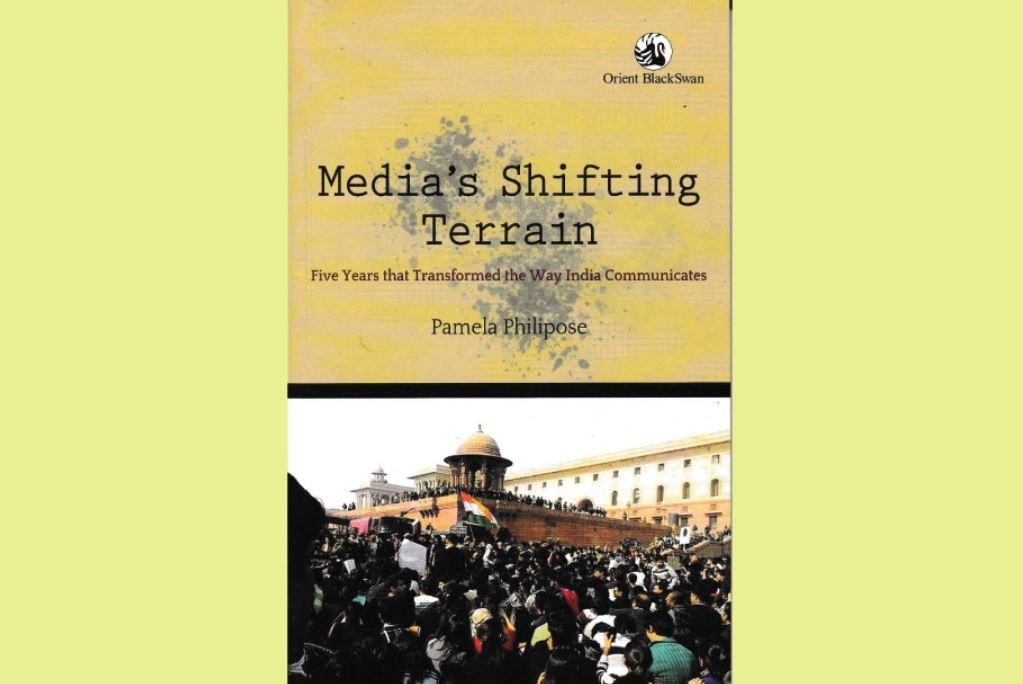
“Digitalisation has shaped and will continue to shape this convergence,” Philipose writes in “Media’s Shifting Terrain – Five Years that Transformed the Way India Communicates” (Orient Blackswann/pp 302), covering the period from the launch of the IAC, through the Nirbhaya gang-rape of 2012, the arrival of the AAP and its brief stint in power in 2013, the rise of the BJP and Narendra Modi in 2014, and the AAP returning to power with an overwhelming majority in 2015.
A quarter century ago, the nature of media content was “fundamentally changed” by the 24×7 TV news cycle. The difference between that “churn” and the contemporary scene today “is that the very pace of the change has exponentially accelerated as digital pathways allow global capital to access markets across the world more efficiently than ever” Philipose notes.
Thus, the data gleaned from users will go to fuel the next wave of the information revolution through artificial intelligence (AI), bring about an era when large tech companies launch products “not for the revenue they bring through the content they circulate but through the data generated through such circulation of content, which can then be monetised through other products driven by AI”. Philipose writes.
“Non-human processes will raise the speeds at which news/information is generated and it will be tailored to the needs and proclivities of discrete audiences and delivered to them with an unimaginable efficiency,” the author notes.
So, if journalism underwent a “complete overhaul” with the age of satellite television, “media functioning in the digital age is undergoing multiple, shape-shifting disruptions, all of them occurring simultaneously along different axes”, the book points out.
At the same time, projecting the scenario of the future “would be entering unchartered territory” but “three codundrums emerge clearly at the present moment”.
The first is the “asymmetrical nature” of access “largely because it is easier to achieve technological inclusion than social inclusion”.
The second conumdrum is that being digital have-nots “does not protect people from the dangers of the internet world, like privacy violations and digital disinformation or fake news”.
The third conundrum “is the drive for the control of audiences by a range of actors through various technological devices and strategies”.
To this extent, Philipose writes, the electoral triumphs of a politician like Narendra Modi, not only in the 2014 general elction but also in a series of subsequent state elections, “were crucially hinged on the creation of hyper-partisanship through the most sophisticated use of media platforms and technologies that the country had ever seen”.
The impact of this “far outlived” the elections themselves, “with the consequent polarisation permiating Indian society and politics, and teams of ‘influencers’ set up for elections continuing to influence the political discourse through interventions like trolling and the coordinated generation of fake news”, the book concludes.
